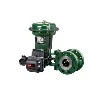

Step onto any plant floor and stand next to a control valve, and you'll probably find yourself asking what actually makes the thing open and close.
Pick the wrong one, and it's not just money down the drain. You're looking at real safety hazards, unplanned shutdowns, and headaches when it comes time for hazardous area compliance audits.
Below I'll break down the three main actuator types you'll run into in the field, how they actually hold up day to day, and how to size up the right one for your application - no over-engineered specs, no cutting corners on what matters.
Quick Answer
For hazardous areas and fast emergency shutdowns, pneumatic actuators are the standard pick. If you need tight positioning accuracy and seamless digital control integration, go electric. For large, high-pressure valves that demand extreme thrust, hydraulic is the only practical option.
There's no one-size-fits-all winner - your final call comes down to valve type, site conditions, available utilities, and long-term maintenance plans.
The valve body itself is just cast metal bolted to pipe. It doesn't do anything on its own. The actuator is the part that does the work - takes an input signal, turns it into motion, and adjusts how much fluid runs through the line. No actuator, and you've got a static pipe fitting, nothing more.
You'll see three main types across refineries, chemical plants and pipeline sites. None of them are "better" overall; each was built for a specific set of conditions you run into in the field.
How they work, at a basic level
Every actuator does the same core thing: turns a control signal into physical movement.
They all need two things to run: a power source - compressed air, electricity, or pressurized oil - and a command signal. For most process plants, that signal is either a 4–20 mA electrical loop or 3–15 psig instrument air.
That input gets converted into either linear motion, pushing the valve stem in and out, or rotary motion, turning the valve a quarter turn or more. That's what controls flow. Simple enough, but people still ask why we don't just standardize on one type.
Why we still use all three designs
None of these have made the others obsolete. They've all been around for decades, and each fills a gap the other two can't cover.
Pneumatic actuators showed up first. They're dead simple to build and naturally safe around flammable atmospheres. Electric models picked up steam as plants went digital, since they handle fine positioning and tie straight into modern control systems. Hydraulic units do the heavy lifting - the jobs where air and electric actuators simply can't generate enough force.
You can't just swap one for another on a whim. They're built for different problems entirely.
Side-by-Side Comparison Table
|
Category |
Pneumatic Actuators |
Electric Actuators |
Hydraulic Actuators |
|
Core strength |
Intrinsically safe, fast cycle times |
Micron-level precision, digital connectivity |
Unmatched output force in a small footprint |
|
Common uses |
Hazardous zones, ESD valves |
Fine process control, modern automated plants |
Large pipeline gates, subsea, high-differential valves |
|
Full stroke speed |
1–5 seconds |
15–120 seconds |
Falls between the two |
|
Positioning accuracy |
Good for basic modulating |
±0.001–0.01 mm on high-end models |
Stable even under heavy load |
|
Hazardous area suitability |
Naturally spark-free, no extra enclosures |
Needs certified explosion-proof housings |
Low spark risk, but fluid leaks carry fire risk |
|
Cost notes |
Low upfront cost, high ongoing air system expenses |
Higher buy-in, lower long-term energy costs |
Most expensive supporting infrastructure |
What each type actually handles out in the field
I'll skip the dense spec sheets and talk about what matters on site.
Pneumatic Actuators
This is the workhorse you'll see most often in hazardous areas.
They run on standard plant air, usually 40–120 PSI, pushing against a piston or rubber diaphragm. The classic spring-and-diaphragm design is everywhere in refineries: air pressure pushes the diaphragm down to move the stem, and if you lose air, the spring shoves the valve right back to its fail-safe position.
No electricity needed to move the valve, and it fails to a safe state on its own if supply drops. That's why it's the default for oilfields, refineries and chemical plants - places where flammable vapors hang in the air and a single spark can set off an explosion. No sparks, no need for pricy explosion-proof housings.
They're fast, too. Most cycle fully in 1–5 seconds, which is non-negotiable for emergency shutdowns.
The tradeoff? You won't get super fine positioning. Air compresses, so you can't nail the micron-level accuracy you get with electric actuators. And the air system itself - compressors, dryers, filters, all that piping - costs money to run and keep up.
Electric Actuators
These are popping up more and more as plants modernize their control systems.
Inside is a motor and gear train that turns electrical power into valve movement. Where they really shine is precision. Top-end units can hold positioning accuracy of ±0.001–0.01 mm, with repeatability within ±0.002 mm. For things like reactor temperature and pressure control, that level of consistency directly cuts down on waste and keeps product quality steady.
They only draw power when they're moving, no constant air supply running 24/7. Overall system efficiency lands around 75–80%, which is a huge step up from pneumatic setups. They're quiet, too - no compressor rumble, no hissing air leaks.
And they plug straight into modern DCS, feeding back position data, diagnostics, status alerts, all over digital signals.
The catch? Hazardous areas get expensive fast. You need full explosion-proof enclosures for explosive atmospheres, and that adds a lot to the upfront cost. They're also much slower - full stroke can take anywhere from 15 to 120 seconds.
Hydraulic Actuators
When you need serious force, this is what you reach for.
Operating principle is similar to pneumatic units, but with pressurized oil instead of air. Since oil doesn't compress, a hydraulic actuator the same size as a pneumatic one can put out up to 25 times more force.
That's why you see them on huge pipeline gate valves, subsea valves, valves running under extreme pressure differential - applications where the other two types just can't generate enough thrust. Long-haul oil pipelines and offshore platforms rely on them for exactly this reason.
The downside is complexity. You need pumps, reservoirs, filters, control valves, miles of tubing - way more supporting infrastructure than air or electric setups. Leaks are a constant headache, and you're looking at regular maintenance to keep contamination out and pressure up.
When Does a Control Valve Need a Valve Positioner?
A lot of field techs ask whether every control valve needs a positioner - short answer: no, but most modulating applications perform far better with one installed. Positioners mount between the control signal and actuator, comparing actual stem position to the commanded signal and adjusting air supply to correct for friction, packing wear, or pressure drop across long tubing runs.
You'll almost always need one for precise flow modulation, high differential pressure applications, or split-range control setups. They're also necessary if you need real-time position feedback or diagnostic data for your control system. Simple on/off valves with no accuracy requirements usually work fine without a positioner.
Picking the right one for the job
Decision Checklist
Work through these before locking in a design:
✅ Valve type & size (linear / quarter-turn)
✅ Required output force & thrust
✅ Response speed needs
✅ Site hazard classification & environment
✅ Available on-site utilities (air, power)
✅ In-house maintenance capabilities
There's no universal best choice. It all comes down to what your specific application needs.
First, nail down how much force you actually need. If you're moving a large valve under high differential pressure, hydraulic is basically your only option. Most standard process valves work fine with either pneumatic or electric.
Speed is next on the list. Pneumatic is far and away the fastest, hydraulic sits in the middle, and electric is the slowest. If you need reliable emergency shutdowns, electric usually won't meet the mark.
Precision is another big deciding factor. Electric is unmatched for fine flow control. Pneumatic works perfectly for basic on/off and simple modulating duty. Hydraulic holds its accuracy well even when fighting heavy loads.
Your site environment will narrow options quickly. In classified hazardous areas, pneumatic is the natural first pick for intrinsic safety. For clean, controlled indoor facilities, electric makes far more sense.
Don't fixate only on upfront cost, either. Pneumatic actuators are cheaper to buy, but running compressed air 24/7 adds up fast over time. Electric costs more out the gate, but energy savings usually cover the difference in 2–3 years. Always look at total cost of ownership, not just the sticker price.
And don't sleep on fail-safe requirements. Pneumatic and hydraulic can both use spring return for safe positioning on supply loss. Electric actuators need backup batteries or capacitors to fail to a safe state.
Wrapping up
At the end of the day, there's no "best" actuator - only the best fit for your specific problem. Pneumatic wins for safety and speed in hazardous areas, electric for precision and energy efficiency, and hydraulic for raw force on heavy-duty valves.
They're separate tools for separate jobs, not upgraded versions of the same thing. Next time you're walking the plant floor checking valves, start with what the valve actually needs to do, and the right actuator type will usually become clear on its own.
Not sure what fits your application? Reach out to our team and we'll walk through your options with you.
FAQ
Are pneumatic actuators always intrinsically safe?
They don't generate sparks during operation, which makes them a natural fit for flammable environments, but full certification depends on accessories like solenoids and positioners. Always confirm ratings match your site's hazard class.
Can electric actuators go in Class 1 Div 1 areas?
They can, but only with certified explosion-proof enclosures and properly sealed conduit. The added cost is substantial compared to pneumatic options, so it's usually only justified where precision is non-negotiable.
Do hydraulic actuators work in cold climates?
They can, but you need temperature-rated hydraulic fluid and optional heat tracing. Cold oil thickens and slows response, and extreme low temps can cause seal failures without proper winterization.
Can you add a positioner to an existing pneumatic actuator?
Most standard linear and rotary pneumatic actuators support aftermarket positioner mounting. It's a common upgrade for sites wanting better modulating accuracy without replacing the whole actuator.