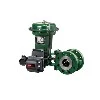

Two Fisher FIELDVUE digital valve controllers show up on almost every control valve inquiry, and the question is always the same: DVC2000 or DVC6200? They both sit on the actuator, both take a 4-20 mA signal, and both run the same ValveLink software. From the desk it's easy to assume the DVC6200 is just the newer, pricier version of the DVC2000.
That assumption gets buyers into trouble. They aren't a new-and-old pair. Emerson sells both at the same time, and the two instruments were built for different jobs. They even share the same position feedback technology, the linkage-less Hall effect pickup that the DVC2000 was the first Fisher instrument to use.
Picking the right one comes down to five questions: what protocol your control system speaks, what kind of actuator is underneath, whether you want diagnostics while the valve is running, whether the valve sits in a safety loop, and how much you want to spend. Work through those and the answer is rarely close.
What the two controllers actually share
Before we split them, note what isn't different, because sales brochures tend to bury it.
Both are two-wire, 4-20 mA electro-pneumatic digital valve controllers. Both read valve position through a linkage-less, non-contact Hall effect sensor reading a magnet array mounted on the stem or shaft, with no mechanical linkage and no parts that wear against each other. This is the feedback design that handles vibration and corrosive atmospheres better than the old potentiometer links. It launched on the DVC2000 back in 2004; tens of thousands of units ran in the field with no failures of the feedback itself, and Emerson later carried the same design over to the DVC6200. The DVC6200 MOC guide is blunt about it, calling the DVC6200 feedback "DVC2000 technology."
Both are commissioned and diagnosed the same way too, with a HART communicator, ValveLink, or ValveLink Mobile: auto travel calibration, alerts, and the same test routines. So if your crew already knows the DVC2000, the DVC6200 won't send them back to school.
Where the two instruments actually diverge
Here's the short version. The DVC2000 is the compact, single-acting, HART-only workhorse for routine modulating loops. The DVC6200 is the modular platform: more protocols, single- and double-acting, wider actuator and pressure range, stainless housing option, deeper diagnostics, and a separate safety-rated version.
The line items below come straight off Emerson's product selection bulletin.
|
Area |
Fisher FIELDVUE DVC2000 |
Fisher FIELDVUE DVC6200 |
|
Role |
Compact standard controller for routine modulating service |
Modular platform for advanced, critical and safety service |
|
Actuator action |
Single-acting |
Single-acting direct and reverse, plus double-acting |
|
Communication |
HART 5, 4-20 mA only |
HART 5 or HART 7 (DVC6200H), FOUNDATION fieldbus (DVC6200F), PROFIBUS PA (DVC6200P) |
|
Position feedback |
Linkage-less non-contact Hall effect |
Same linkage-less Hall effect, plus optional remote mount DVC6205 base with DVC6215 sensor |
|
Diagnostics (ordered tiers) |
AC, HC, AD or PD selectable at order |
Full HC, AD and PD across the range; SIS diagnostics on DVC6200 SIS |
|
Housing |
Aluminum |
Aluminum or stainless steel |
|
Max inlet pressure |
7 barg (100 psig) |
10 barg (145 psig) |
|
Ambient temperature |
-40 to +80 C |
-40 to +85 C, down to -52 C with fluorosilicone |
|
Local interface |
Standard 4-button LUI with full-text LCD, 12 languages |
Condition indicator LEDs; interface varies by build; LCP200 panel for the SIS unit |
|
Safety rating |
None |
DVC6200 SIS rated SIL 3 (exida) with partial stroke testing |
|
Typical home |
Smaller linear valves, standard loops, tight budget |
Large, rotary or double-acting valves, bus networks, condition-based maintenance, SIS loops |
The six differences that actually drive the decision
1. Protocol
Look at the host first. A DVC2000 is a HART 5 instrument, full stop. If your DCS speaks HART point-to-point, that's fine and you can spec either. On a FOUNDATION fieldbus segment you need the DVC6200F, and on PROFIBUS PA you need the DVC6200P. There's no fieldbus version of the DVC2000 and no firmware upgrade that adds one, so the control system architecture settles this one for you before you open a catalog.
2. The actuator under the hood
This is the one people miss, so check the actuator before anything else. A DVC2000 only runs single-acting, and it's built for the smaller linear valves with short strokes, where its small housing genuinely helps. The DVC6200 is a different animal. It does single-acting direct and reverse, and double-acting too, and its rated travel runs from 6.35 mm to 606 mm, about 0.25 to 23.9 inches on linear actuators and 45 to 180 degrees on rotary. On a piston actuator or a double-acting cylinder, on a big globe valve or a quarter-turn drive, it's the DVC6200 every time.
Then check supply pressure. The DVC2000 stops at 7 barg (100 psig) at the inlet. The DVC6200 goes to 10 barg (145 psig). If the actuator needs that extra pressure to stroke or to seat tight, the DVC2000 simply won't do it, and no discount changes that.
3. How deep the diagnostics go
FIELDVUE diagnostics come in four order tiers, so the label on the box matters. AC is auto calibration only, your basic positioner. HC adds HART communication and the alerts. Step up to AD and you get the off-line tests, valve signature, step response, dynamic error band, the ones you run with the valve isolated. PD is Performance Diagnostics, and that runs while the valve is live. It watches the valve control the process without moving it past its normal setpoint changes, and it leans on statistical models to flag the usual suspects: air supply trouble, friction that's creeping up, deadband, calibration drifting off.
One thing to get straight, the DVC2000 is not locked to basic diagnostics. You can order it HC, AD, or all the way up to PD. In practice most DVC2000s leave the factory as AC or HC. The DVC6200 is where Emerson built the diagnostics out. You get full PD on every protocol, a pressure-control fallback if the position feedback ever drops out, the whole dynamic test suite, and the software around it, ValveLink, AMS, the Plantweb Valve Health dashboard. If you're running condition-based maintenance on a valve that actually matters, start from the DVC6200 so you aren't bolting things on later.
4. Safety instrumented systems
Now the SIS question. If the valve is in an interlock or an ESD shutdown loop, none of the rest matters, because the DVC2000 has no safety version at all. The DVC6200 SIS is its own model, certified by exida for SIL 3 as the safety shutdown device, with partial stroke testing and SIS diagnostics built in and a low-bleed relay fitted as standard. You see the same arrangement on skids all the time, a DVC2000 holding the control valve and a DVC6200 SIS on the trip valve beside it.
5. Housing, mounting, and the environment
Housing is the first giveaway. You only get aluminum on the DVC2000. The DVC6200 is offered in aluminum or stainless steel and carries a wider spread of approvals, CSA, FM, ATEX, IECEx, UKEx, IP66, and the marine societies on top. That's the main reason offshore and chemical buyers default to it.
The DVC6200 is modular too, so the relay, I/P, and electronics come out without you pulling field wiring or pneumatic tubing. It also has a remote mount option for tight or hot spots. You bolt the DVC6205 base to a pipe or wall and run it with a DVC6215 travel sensor rated to 125 C (257 F). The DVC2000 has no remote version. Temperature is another split, the DVC6200 drops to -52 C with fluorosilicone elastomers, and the standard DVC2000 bottoms out at -40 C.
6. The local interface, where the DVC2000 wins
Here's one the comparison tables often get backwards. Out of the box the DVC2000 has a 4-button local interface and a full-text LCD in 12 languages, and that covers setup and calibration without a communicator. The DVC6200 runs on condition indicator LEDs, and what you get depends on the build, the SIS unit works off an external LCP200 panel. For teams that commission on the plant floor without a laptop, that's the DVC2000 being the easier one to live with.
So which one should you buy?
When the job is plain, the DVC2000 is usually the call. That's your HART 4-20 mA point-to-point loop on a small or medium single-acting spring-and-diaphragm valve, supply at or below 7 barg, no bus network and no SIL duty. It's the cheaper unit and you still get an LCD on the housing. That covers a lot of ordinary control valves, and the DVC2000 handles them well.
You step up to the DVC6200 the moment any one of these shows up. Your loop runs on FOUNDATION fieldbus or PROFIBUS PA. The actuator is double-acting, piston, rotary, or long-stroke. Supply pressure runs above 7 barg. You need stainless steel, remote mounting, or the extreme-temperature option. Or you're building a condition-based maintenance program on full PD, and the valve is critical enough that a trip costs real production. Any one of those is enough to move you off the DVC2000.
On safety shutdown duty there's nothing to debate, it has to be the DVC6200 SIS.
Can a DVC6200 replace a DVC2000, or the other way around?
Call it an upgraded version and you're already wrong, and it's an expensive mistake. They're parallel models, and whether you swap comes down to the application. It isn't an automatic upgrade.
Quite often a DVC6200H fits the same Fisher GX, 657, or 667 actuator the DVC2000 came off. Both are HART, and the mounting footprint lines up. "Drop-in" is possible, it just isn't guaranteed. Don't assume it, though. Walk through the checks.
Start with the action, single-acting or double-acting. Check which relay is fitted and what the supply pressure is. Confirm the mounting kit, and make sure the magnet array lines up with the feedback sensor. Then check the protocol, and recall which diagnostic tier you originally ordered. Get any one of those wrong and the "drop-in" comes back as a returned part.
Going the other way, a DVC2000 in place of a DVC6200, only works on a HART, single-acting, smaller valve. It also needs to be a job where no advanced diagnostics or safety rating were specified. Best not to guess from a model-number suffix. Give the supplier the valve and actuator tag data, the nameplate of the existing positioner, and the loop protocol, and let them confirm the selection.
Frequently asked questions
What is the single biggest difference between the DVC2000 and the DVC6200?
Not the feedback, they share the same linkage-less Hall effect pickup. The real gap is scope. The DVC2000 is a compact, single-acting, HART-only controller for standard loops. The DVC6200 does a lot more. It runs HART, FOUNDATION fieldbus, and PROFIBUS PA, and it takes both single- and double-acting actuators. Its diagnostics go deeper, it comes in stainless and remote-mount builds, and it has a SIL 3 safety version the DVC2000 simply doesn't.
Is the DVC6200 the newer replacement for the DVC2000?
No, the two are sold side by side. The DVC6200 actually replaced the older DVC6000, and it used the Hall effect feedback the DVC2000 had already proven. Let the application decide, not the release date.
Can the DVC2000 do FOUNDATION fieldbus or PROFIBUS?
It can't. The DVC2000 is HART 5 over 4-20 mA only. For fieldbus you need the DVC6200F, and for PROFIBUS PA the DVC6200P.
Is the DVC2000 limited to basic diagnostics?
No. It can be ordered with AC, HC, AD, or PD, and PD includes on-line in-service diagnostics. The DVC6200 simply carries the diagnostics further, with full PD across every protocol, pressure fallback, and dedicated SIS diagnostics.
Which is better for oil, gas, and chemical plants?
On a critical modulating valve I'd take the DVC6200, the PD diagnostics, stainless or remote options, and the wider approvals. On an emergency shutdown or interlock valve it has to be the DVC6200 SIS, SIL 3 with partial stroke testing.
Will a DVC6200 mount straight onto a DVC2000 valve?
Often yes on HART single-acting Fisher GX, 657, or 667 actuators, but not safely by assumption. Verify the relay, action, supply pressure, mounting kit, magnet alignment, protocol, and diagnostic tier first, or have the supplier confirm the full bill of materials.
Whether you're pricing a Fisher DVC2000 or DVC6200, checking a quoted model, or chasing genuine FIELDVUE spares and mounting kits, send us the valve and actuator tag data and the nameplate of the instrument you're replacing. A photo of the application helps. We'll spec the right controller and tell you straight whether it's really a drop-in.
• +852 92039110.
• serena@valve-sjwy.com.
References
• Emerson, Fisher FIELDVUE Digital Valve Controller Product Selection bulletin (DVC2000 and DVC6200 order matrices and diagnostic tiers)
• Emerson, Fisher FIELDVUE DVC6200 Digital Valve Controller Product Bulletin D103415X012 (62.1:DVC6200)
• Emerson, Management of Change: Replacing DVC6000 with DVC6200 (DVC6200 linkage-less Hall effect feedback described as DVC2000 technology)
• Emerson, DVC6200 SIS product selection (SIL 3, partial stroke testing, SIS diagnostics)