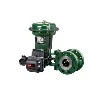

It happens more often than you might think. A maintenance engineer replaces a limit switch on a control valve because the DCS shows no "open" signal-only to find the valve still drifts under load. A procurement specialist orders a smart positioner for a simple on-off ball valve, paying for diagnostics that will never be used. These aren't rare mistakes. They stem from a persistent mix-up between two components that look similar to most people, but serve completely different functions.
The valve positioner and the limit switch are both mounted on the valve assembly, and both connect to the control system. But they do different jobs. The positioner is an active regulator: it continuously adjusts the valve position. The limit switch is passive: it only signals when the valve reaches its mechanical stop. Getting this wrong isn't just a technical detail – it hits plant reliability, drives up maintenance costs, and degrades control performance.
This article explains how each device works, what types are available, and which model to pick for different applications. It also includes a side-by-side comparison of common models and points out the mistakes people make most often when choosing one.
What a Valve Positioner Actually Does
A valve positioner is a closed-loop control device. It receives a modulating signal (typically 4-20 mA from a DCS or PLC), compares that setpoint with the actual valve stem position, and adjusts the actuator pressure until the two match. The positioner doesn't just open or close the valve; it can hold the valve at any position from 0% to 100%, accounting for packing friction, changes in process pressure, and vibration.
If your process requires continuous modulation for flow, pressure, temperature, or level control, you need a positioner.It answers the question "how much should the valve open?"
Types of Positioners – A Model-Level View
Most positioners come in three basic types. Price is part of the story, but not the main one. The table below uses Fisher models as examples. These are familiar to most engineers, but the same principles apply to other major brands.
|
Type |
Representative Models |
Signal |
HART / Diagnostics |
Typical Application |
|
Pneumatic (analog) |
3582, 3570, 3610J |
3–15 psi pneumatic |
None |
Legacy plants with all-pneumatic control loops |
|
Electro-pneumatic (analog) |
3582i, 3620J |
4–20 mA analog |
None |
Simple modulating duty, no diagnostic requirement |
|
Digital / Smart DVC |
DVC2000, DVC6200, DVC7K |
4–20 mA + HART |
Full diagnostics, valve signature, predictive maintenance |
Modern DCS environments requiring health monitoring and performance trending |
Pneumatic positioners are mechanically rugged and don't require electrical power. They also hold up well in high-temperature areas or places with high electromagnetic interference.The trade-off is limited accuracy and zero remote feedback. They are increasingly rare in new installations but still common in older refineries and chemical plants.
Electro-pneumatic positioners convert a 4–20 mA signal into a pneumatic output. They offer better accuracy than pure pneumatic types and are the workhorse of many mid-tier processes. However, they rely on mechanical feedback linkages and provide no digital communication.
Smart digital positioners are now the default choice for critical loops. These units pack a microprocessor, a high-resolution position sensor, and a communication stack that supports HART, Profibus, or Foundation Fieldbus. Their real value shows up in diagnostics: they can run valve signature tests, track friction trends, and raise an alarm before the valve actually sticks.The DVC6200, for example, is widely used in refining and chemical service because of its ruggedness and diagnostic depth. The newer DVC7K series adds enhanced predictive analytics and simplified calibration.
It is worth noting that "smart" does not automatically mean "better for every application." For a simple flow loop with stable process conditions and no host asset management system, an analog electro-pneumatic positioner may still be the most cost-effective choice. The added cost of diagnostics only pays off when the plant has the infrastructure-and the personnel-to act on the data.
Limit Switches: What They Do and What They Don't
A limit switch is often called a valve position monitor or feedback switch, but its job is simple: it tells the control system when the valve hits its fully open or fully closed stop. It sends a discrete on/off dry-contact signal to confirm that the valve has reached the end of its travel.
Unlike a positioner, a limit switch does not modulate. It cannot detect 20%, 50%, or 80% travel. It only answers the binary question: "is the valve fully open or fully closed?"
Mechanical vs. Inductive Limit Switches
Two common types exist:
Mechanical contact switches rely on a lever or plunger that a cam on the valve shaft pushes. They are straightforward devices: they hold up well in clean environments and don't need electrical power. The catch is wear. After hundreds of thousands of cycles, oxidation on the contacts, spring fatigue, or other mechanical degradation can cause the switch to fail. It may simply stop changing state when it should.They are still the most widely used type for standard on-off valves in dry, indoor conditions.
Inductive proximity switches have no moving parts.These switches use an electromagnetic field to detect a metal target, typically a vane or disc attached to the valve stem. Their service life is significantly longer, with many rated for over 5 million cycles, and the housing is sealed against dust and moisture. They are particularly well suited to harsh environments and high-frequency cycling. With the right ATEX or IECEx certification, they also work in explosive atmospheres. The upfront cost is higher, but that usually pays off through fewer replacements and less unplanned downtime.
Proximity switches have a quirk that trips people up: they need to be mounted at just the right distance. A couple of millimeters off and the signal starts dropping out. Mechanical switches are more forgiving if things aren't perfectly aligned, which is why you still see them all over the plant, even though they don't last as long.
The Core Differences – Side by Side
|
Aspect |
Positioner |
Limit Switch |
|
Primary function |
Active control – modulates valve opening |
Passive feedback – signals end positions |
|
Signal type |
Analog (4–20 mA) or digital bus |
Discrete (dry contact, NPN/PNP) |
|
Position feedback |
Continuous (0–100%) |
Binary (open/closed only) |
|
Valve type |
Control / modulating valves |
On-off / shut-off valves |
|
Diagnostics |
Yes (smart types) |
No (only switch status) |
|
Role in loop |
Regulates process variable |
Confirms valve status for safety/interlock |
The distinction is not about which device is better-they serve different purposes. A control valve without a positioner cannot maintain precise setpoint; an on-off valve with a positioner is over-engineered and adds unnecessary cost and complexity.
Selection Mistakes That Cost Time and Money
The most common error is fitting a positioner to a simple on-off valve because the engineer assumes "more control is better." The result is a device that never uses its modulating capability, while the plant pays a premium for a product that requires calibration and is more prone to failure in infrequent operation.
The opposite mistake-installing only a limit switch on a modulating valve-is equally problematic. The DCS may receive the "open" signal, but the actual valve position could be 80% due to friction or overshoot. Without a positioner, the loop has no way to correct the error.
A less obvious pitfall: using an analog positioner in a plant that is migrating to a digital asset management system. The positioner itself may work fine, but the inability to upload valve signature data or trend friction increase over time becomes a blind spot when predictive maintenance is the goal. Retrofitting a smart positioner later usually involves additional wiring and calibration downtime.
Installation and Maintenance – Practical Pointers
For positioners, routine checks should include:
- Confirming the input signal matches the commanded position within the specified accuracy (typically ±0.5–1.0% of span per IEC 60534-4).
- Checking supply pressure and filter cleanliness – contaminated air is a leading cause of positioner drift.
- Performing a stroke test periodically to detect any increase in friction or seating wear.
For limit switches, the focus is different:
- Inspect mechanical contacts for oxidation or pitting – replace if contact resistance increases.
- For inductive types, verify the sensing gap and target alignment; even slight mechanical shifting after actuator maintenance can cause false signals.
- Ensure the switch housing remains sealed (IP67 or IP68) if installed in wash-down or outdoor areas.
Both devices benefit from documented installation records and baseline performance data. That data becomes invaluable when troubleshooting an intermittent fault that only appears during a specific phase of the process cycle.
FAQ – Questions We Hear from Plants
Q: Can a valve have both a positioner and a limit switch?
Yes, and it is common for critical control valves. The positioner handles modulation; an additional limit switch (or two, for open and closed) provides a hardwired end-position signal to safety interlock systems, bypassing the analogue position feedback. This is a common practice in SIL-rated loops.
Q: How do I know if a limit switch is the reason my valve isn't responding?
A limit switch doesn't control the valve. It just reports the valve's position. So if the valve isn't moving, the switch isn't the problem. Check the actuator, positioner, solenoid, or air supply instead. But if the valve moves and the DCS still shows no change, then the limit switch is the first place to look.
Q: Do smart positioners eliminate the need for limit switches?
Not entirely. While smart positioners can send position data over HART, many safety systems still require a discrete contact for emergency shutdown or interlock purposes. It is not a redundancy issue; it is a signal type requirement.
Q: Is the Fisher DVC6200 compatible with all actuators?
The DVC6200 mounts on most common linear and rotary actuators with appropriate mounting kits, but always check stroke length and rotation angle compatibility. The DVC2000 is a more compact alternative for smaller actuators.
Final Takeaway
Positioners are for continuous process control. Limit switches are for confirming whether a shut-off valve is fully open or closed. They are not alternatives. They work together in different roles.
For procurement, the cost question is not about the price of the device alone. A smart positioner may cost three times as much as an analog unit, but if it saves one unplanned shutdown through early detection of valve stiction, it pays for itself many times over. Conversely, a limit switch in a clean, low-cycle application does not need to be the premium inductive type-a mechanical switch from a reputable brand will likely outlast the valve itself.
Engineers and buyers who treat these two components with the respect they deserve-not as interchangeable accessories but as purpose-built instruments-will see fewer field surprises and lower maintenance overhead. That is the kind of reliability that shows up on the bottom line.
Need help selecting the right positioner or limit switch for your specific valve and process?
Contact our technical support team with your valve data and control requirements-we will send you a recommended configuration and a side-by-side comparison of applicable models.